APQ Wiki – Optics and Telescope Technology
The APQ Wiki explains key terms in technical and astronomical optics and directly links related topics. This edition contains 175 terms. In addition to concise definitions, formulas, schematic diagrams, cross-references, and literature references are provided wherever technically useful. The expanded scope now also covers precision-optics manufacturing, optical testing, optomechanics, optical-system synthesis, and the interaction between optics and detectors.
Terminology: The number of optical elements in an objective is described by terms such as Doublet, Triplet, Quadruplet, and Multiplet. These structural terms are distinct from chromatic correction classes such as Dichromat, Trichromat, Apochromat, Polychromat, and Superachromat. Calcium fluoride is written as CaF₂.
Formulas and diagrams are intended to place a term in context; they do not replace a complete specification or system analysis. For Strehl, MTF, spot diagrams, chromatic correction, and tolerancing in particular, wavelengths, field points, focus conditions, spectral weighting, and test conditions must be stated.
A–Z: A | B | C | D | E | F | G | H | I | K | L | M | N | O | P | Q | R | S | T | U | V | W | Z | Literature and further reading
A
Graphical representation of optical glasses using their Abbe number and usually refractive index or a relative partial dispersion. Extended glass maps also reveal departures from the normal dispersion line and therefore support material selection for chromatic correction. See also: Partial dispersion
The Abbe number (also Abbe constant or constringence) characterizes the dispersion of a transparent optical material. It is denoted by the Greek letter ν; νd is commonly used for the d-line definition and νe for the e-line definition. For comparable refractive index, a larger Abbe number generally means lower chromatic dispersion in the visible range. See also: Dispersion
Condition for coma-free imaging of an axial object point at finite aperture. It relates ray height, refractive index, and ray angle on the object and image sides and is a central criterion of aplanatism. See also: Aplanat / aplanatism
General term for departures of a real image from the ideal geometrical or diffraction-limited image. Important forms include Spherical aberration, Coma, Astigmatism, Field curvature, Distortion, and chromatic aberrations.
Conversion of part of the incident optical radiant power into other forms of energy within a material. Together with reflectance and transmission, it determines the spectral losses of an optical system. See also: Reflectance, Transmission
Optical system in which two selected wavelengths have the same paraxial focus. An achromat reduces primary chromatic aberration but leaves a secondary spectrum. The term describes the correction class, not the number of lenses. See also: Chromatic error, Secondary spectrum
Relatively slow control of the shape or position of large optical components in order to compensate quasi-static errors caused by gravity, temperature, and mechanical loads. It must be distinguished from the faster adaptive optics.
Method for rapid, usually closed-loop correction of time-varying wavefront errors by means of a wavefront sensor, controller, and deformable optical element. In astronomy it is used primarily to compensate atmospheric turbulence. See also: Wavefront error
Defined axial spacing between two optical surfaces filled with air or another gas. Air gaps are independent design parameters and influence aberrations, thermal behavior, reflection losses, and assembly tolerances.
The central bright region of the diffraction pattern produced by an ideal circular aperture. Its size is set by wavelength and Focal ratio and provides a fundamental scale for diffraction-limited imaging.
Optical system in which astigmatism is largely corrected over the intended image field. Photographic and scientific anastigmats normally also minimize other field aberrations such as coma and field curvature; the term is therefore meaningful only together with field size, spectral range, and image-quality criterion. See also: Astigmatism, Field curvature
Departure of a material's relative partial dispersion from the normal relationship followed by conventional optical glasses. Such materials, including fluorophosphate glasses and crystalline CaF₂, provide additional degrees of freedom for correcting the secondary spectrum. See also: Partial dispersion, Fluorite (CaF₂)
A thin-film system applied to optical surfaces to reduce Fresnel reflections and thereby increase Transmission and contrast. Broadband multilayer coatings are matched to the intended spectral range and substrate materials.
Stop that determines the angular extent of the axial ray bundle and therefore the effective aperture of the system. Its image in object space is the entrance pupil; its image in image space is the exit pupil. See also: Entrance pupil, Exit pupil
Aplanatism denotes simultaneous correction of spherical aberration and coma for a specified object and image point. Under suitable conditions, an aplanatic system satisfies the Abbe sine condition. See also: Spherical aberration, Coma
An optical system with substantially more advanced chromatic correction than an achromat. In the classical Abbe definition, three wavelengths are brought to a common axial focus and the Spherochromatism (Gauss error) is corrected for two widely separated wavelengths. In astronomy, “APO” is sometimes used more broadly; the actual polychromatic image quality remains decisive.
Artificial point source used to test, align, and evaluate telescope optics. A source at finite distance does not produce exactly parallel incident rays, so source diameter, distance, and, where applicable, collimator geometry must be chosen and documented appropriately.
An optical surface whose shape departs from a sphere or plane. Aspheres can correct selected aberrations with fewer elements or design degrees of freedom, but place higher demands on manufacturing and metrology.
An off-axis aberration in which sagittal and tangential ray bundles have different focal positions. As a result, an object point is not imaged as a point in a single plane.
Optomechanical design intended to compensate temperature-induced changes in refractive indices, lengths, and spacings so that a critical system quantity—often the focus position—remains as constant as possible over the specified temperature range. dn/dT, thermal expansion, and the mount are considered together. See also: Coefficient of thermal expansion (CTE)
Refraction of astronomical light in Earth's atmosphere. The effect shifts the apparent direction of an object and is wavelength dependent; at large zenith distances it can produce appreciable atmospheric dispersion.
Test or alignment method in which a ray bundle emitted by an optical system is reflected by a mirror and returned through the system. This produces a double pass that makes certain angular and imaging errors especially sensitive.
Measuring telescope that combines collimator and observing telescope in a common optical path. An illuminated reticle is projected outward through the objective, reflected by a surface, and observed again, allowing very small angular deviations to be measured precisely.
B
The available mechanical distance from a defined mounting or reference plane to the intended image plane. In photographic systems, the combined optical/mechanical path of adapters, filters, camera, and any corrector must match the specified back focus.
Property of anisotropic media to have different refractive indices for different polarization directions. An incident ray can therefore split into ordinary and extraordinary components.
An optical filter that selectively suppresses unwanted spectral regions while transmitting the desired band. In an optical system it must be determined whether the filter merely limits the detector band or is an integral part of the intended spectral system design.
C
Accurate alignment of optical surfaces and elements relative to a reference axis. Decenter and tilt can generate asymmetric aberrations and significantly degrade the calculated performance of a high-quality objective.
Departure of optical surfaces or elements from the intended common reference axis. Decenter and tilt can generate asymmetric aberrations, particularly coma and astigmatism. Centering errors are therefore manufacturing, assembly, and alignment quantities.
Central blockage of the entrance aperture, typically by a secondary mirror and its support in reflecting telescopes. It changes the diffraction distribution and therefore the PSF and MTF even when the outer aperture diameter remains unchanged.
Ray from an off-axis object point that passes through the center of the aperture stop. It is a principal construction ray for field position, pupil imaging, telecentricity, and vignetting. See also: Aperture stop, Telecentricity
Wavelength dependence of imaging caused by the Dispersion of optical materials. Principal forms are longitudinal chromatic aberration, lateral chromatic aberration, and wavelength-dependent variation of monochromatic aberrations.
General term for chromatic imaging errors. These include longitudinal color, lateral color, and wavelength-dependent changes in monochromatic aberrations. See also Chromatic aberration and Spherochromatism (Gauss error).
The wavelength-dependent position of the best or paraxial focus. A focal-shift curve s′(λ) directly shows how well an objective is longitudinally color-corrected across its intended spectral range.
The actually usable, mechanically unobstructed diameter or cross-section of an optical element or system. It must be distinguished from the nominal size of a lens blank or cell.
Material parameter for relative length change with temperature. Different expansion coefficients of glass, crystal, mount, and tube affect spacings, clamping forces, and focus position and are therefore key input quantities for athermalization. See also: Athermalization
Measure of the ability of optical waves to maintain a stable phase relationship. Temporal coherence is related to spectral bandwidth and determines coherence length; spatial coherence characterizes correlations across the wavefront.
Alignment of optical elements and axes so that a system reaches its intended geometrical configuration. In a refractor this includes, among other things, Centering, tilt, and the positions of objective, tube, and image plane.
Optical system that converts light from a source near its focal plane into an approximately parallel beam, or performs the inverse function. Collimators are used in optical testing, angular measurement, and simulation of objects at infinity.
An off-axis aberration in which a point object produces an asymmetric, comet-like point-spread function. Coma is one of the primary monochromatic aberrations and typically increases with field angle.
A mechanical objective cell whose design influences temperature-induced length and diameter changes so that optically critical relative positions and stress states remain controlled over the intended temperature range.
Parameter describing the type and curvature departure of a conic surface from a sphere. Together with vertex curvature it defines rotationally symmetric conic surfaces such as ellipsoids, paraboloids, and hyperboloids.
Telescope optical path in which additional mirrors direct the light to a largely stationary focus. Heavy or sensitive instruments such as high-resolution spectrographs can therefore be operated in a fixed location.
Solid with long-range ordered atomic structure. Optical crystals can be anisotropic and may exhibit birefringence; crystalline CaF₂ is therefore fundamentally different from amorphous optical glass. See also: Fluorite (CaF₂)
Highest spatial frequency transferred by an ideal diffraction-limited incoherent imaging system. Above this frequency the MTF is zero. The cutoff therefore depends on wavelength and f-number. See also: Spatial frequency
D
Numerical optimization method in which parameter changes are obtained from a locally linearized least-squares problem with additional damping. The damping stabilizes the iteration and limits excessively large steps, making DLS a widely used method in optical design.
Axially symmetric wavefront error caused by displacement of the image plane from the optimum focus position. Defocus changes the point-spread function and is represented as a separate mode in Zernike descriptions.
Axial range around the nominal image plane within which defocus does not exceed a specified image-quality criterion. For a diffraction-limited system, the permissible depth of focus scales approximately with wavelength λ and the square of the f-number N.
An optical system in which a chromatic correction condition is satisfied for two selected colors or wavelengths. The term describes a chromatic correction class, not the number of lens elements.
Wave-optical phenomenon in which light deviates from purely geometrical propagation at finite apertures and edges. Even with a perfect optical system, diffraction determines the finite size of the Airy disk and therefore the fundamental diffraction limit. See also: Diffraction limit
A condition in which imaging performance is governed primarily by the wave nature of light rather than by geometrical aberrations. “Diffraction limited” is not a complete quality statement unless wavelength, field point, spectral weighting, and criterion are specified.
The wavelength dependence of the Refractive index of an optical material. Normal, anomalous, and partial dispersion are key degrees of freedom in correcting chromatic aberrations.
A field-dependent change in image scale that makes straight lines or geometrical proportions appear distorted. Distortion affects geometrical position rather than primarily local point sharpness.
Temperature coefficient of the refractive index of an optical material. It specifies how strongly n changes with temperature and, together with thermal length change, is a key parameter in athermalization. See also: Refractive index, Athermalization
Test method in which light passes twice through the optical system under test and returns to the source after reflection from a high-quality flat mirror. The double pass increases the sensitivity to certain wavefront errors relative to a single pass; the setup, reference surface, and evaluation method must therefore be stated unambiguously.
A term widely used in astronomy for an objective or lens group consisting of two optical elements. “Doublet” describes element count only; it does not imply a particular chromatic correction class.
E
A collective term for optical glasses with low or special dispersion (“Extra-low Dispersion”). The designation alone does not define the performance of an objective; the specific glass, mating glasses, and complete optical design are decisive. See also: Dispersion
The fraction of the total energy of a point-spread function contained within a circle of radius r around the image centroid. It combines diffraction and aberration effects and is particularly useful for detector and survey applications.
The image of the aperture stop as seen from object space. In many telescopes it approximately coincides with the clear objective aperture; its position and size affect ray bundles, Vignetting, and Telecentricity.
The image of the aperture stop formed by the image-side portion of an optical system. In an astronomical telescope, its diameter is approximately the objective diameter divided by the Magnification.
F
Fundamental principle of geometrical optics stating that the actual light path between two points has stationary optical path length. The laws of reflection and refraction can be derived from it.
Angle of an object point, or of its chief ray, with respect to the optical axis. Field angle is a fundamental specification for evaluating wide-field systems and must be stated for spot diagrams, MTF, and other image-quality criteria. See also: Chief ray
An optical correction group designed to improve imaging away from the field center. A field corrector can reduce Field curvature, Astigmatism, and, depending on the design, additional off-axis aberrations; its function is therefore broader than simple field flattening.
An Aberration in which the best image surface is curved rather than flat. Without correction, a flat camera or detector cannot therefore be optimally focused at the center and edge at the same time.
The angular range in object space covered by the optical system or detector. For small angles, field of view is approximately proportional to sensor size and inversely proportional to Focal length.
Stop that limits the extent of the usable object or image field. Unlike the aperture stop, it primarily determines the field rather than the aperture of an axial ray bundle. See also: Aperture stop
Interferometric test arrangement in which reference and test waves are generated at closely spaced optical surfaces or by means of a reference optic. Fizeau interferometers are widely used in precision optics because they measure surface and wavefront deviations with high accuracy.
Crystalline calcium fluoride with very low Dispersion, pronounced anomalous partial dispersion, and high Transmission over a broad spectral range. Optical CaF₂ is a crystal, not an optical glass.
Special optical glasses containing fluoride and phosphate constituents that can exhibit very low Dispersion and anomalous partial dispersion. In suitable combinations they enable highly advanced chromatic correction.
Axial distance from a focus or ray intersection to a specified reference surface. This distance is not identical to focal length because it depends on the locations of the principal planes and on the selected mechanical reference. See also: Focal length
A paraxial characteristic of an optical system that determines, among other things, image scale and Field of view. For objects at infinity, it is the distance from the image-side principal plane to the paraxial focus.
The ratio of Focal length f to effective clear aperture D. A smaller number denotes a “faster” system with a larger ray angle and greater demands on aberration correction.
An optical group that reduces the effective Focal length and therefore the Focal ratio while simultaneously correcting specified aberrations. Reduction alone does not make a high-quality corrector; field size, spectral range, and sensor position must be part of the design.
A shift of the optimum focus caused by wavelength, temperature, filters, mechanical tolerances, or other influences. Chromatic focus shift is a measure of longitudinal color; thermal focus shift describes temperature-induced focus change.
Classical test in which a knife edge near focus blocks portions of the returning beam. Brightness distributions or zonal measurements permit conclusions about form errors of rotationally symmetric optical surfaces.
Mathematical transformation between the spatial and spatial-frequency domains. In linear imaging theory it connects, among other quantities, the PSF and the OTF. See also: Point Spread Function (PSF), Optical Transfer Function (OTF)
Historical designation for prominent absorption lines in the solar spectrum. Lines such as C, d, F, F′, and C′ are traditionally used as reference wavelengths for Abbe numbers, refractive indices, and chromatic correction.
Two approximation regimes of diffraction. Fresnel diffraction describes finite propagation distances with curved wavefronts; Fraunhofer diffraction describes the far-field case or its realization in a focal plane.
Relations for the amplitude and power of reflected and transmitted light at an interface. The coefficients depend on refractive indices, angle of incidence, and polarization and form the basis for evaluating uncoated interfaces and optical coatings.
High-purity amorphous silicon dioxide with good UV transmission, high thermal stability, and relatively low thermal expansion. Unlike crystalline quartz, fused silica is isotropic and is classified as an optical glass.
G
Description of light propagation using rays. It is appropriate when wavelength effects such as diffraction and interference are negligible for the problem under consideration and forms the basis of paraxial imaging, ray tracing, and classical aberration theory.
Fundamental processing stages in precision optics. Grinding establishes geometry and removes material; lapping or fine grinding reduces form error and subsurface damage; polishing produces the optically active surface with very low roughness. Modern processes such as MRF supplement this chain deterministically. See also: Magnetorheological Finishing (MRF)
H
Wavefront test in which a mask with multiple openings divides the aperture into sub-bundles. The measured positions of the resulting spots at one or more planes provide local ray slopes and thereby information about the wavefront. See also: Wavefront error, Shack-Hartmann wavefront sensor (Hartmann-Shack sensor)
Empirical dispersion formula for representing the wavelength dependence of refractive index over a broad spectral range. It is particularly useful in broadband chromatic design and in analyses of superachromatic systems.
Wave-optical principle according to which every point on a wavefront can be regarded as the source of secondary wavelets and the new wavefront is the envelope of those wavelets. It provides an intuitive basis for propagation and diffraction.
I
Field-dependent illuminance or relative signal level in the image plane. It is affected by natural angular dependencies, pupil imaging, and vignetting and must be distinguished from image quality itself. See also: Vignetting
Image contrast describes the brightness difference between bright and dark image structures. The frequency-dependent contrast transfer of a linear imaging system is described by the modulation transfer function (MTF). See also: Modulation Transfer Function (MTF)
The region of the image plane over which an optical system provides usable image quality. It may be stated as a linear image dimension, image circle, or angular range in object space.
Superposition of coherent optical waves, producing spatial or temporal intensity modulation that depends on their phase difference. Interference is the operating principle of many optical metrology methods and filters.
Thin-film optical filter whose spectral transmission is produced by constructive and destructive interference in one or more dielectric layers. Center wavelength and passband generally depend on angle of incidence and refractive index.
Recorded interference pattern containing information about the optical path difference between test and reference wavefronts. Quantitative evaluation can yield surface form, wavefront error, or derived aberration coefficients. See also: Wavefront
A measurement method in which the Wavefront under test is superimposed on a reference wavefront. The resulting interference pattern permits highly accurate determination of form, surface, and wavefront deviations.
Condition under which the point-spread function or wavefront distortion can be regarded as effectively invariant over a limited field. In atmospheric imaging the isoplanatic angle specifies the angular region over which approximately the same turbulence correction is valid.
K
Mounting principle that constrains the six rigid-body degrees of freedom in a defined, minimally overconstrained manner. Proper kinematic mounting reduces stress and makes positioning reproducible under adjustment, assembly, and temperature changes.
L
Transverse chromatic aberration in which magnification or the image height of an off-axis object point depends on wavelength. This produces wavelength-dependent lateral shifts across the image field.
Ratio of image size to object size in paraxial imaging. Depending on the sign convention, the sign indicates the orientation of the image.
Chromatic aberration in which different wavelengths have different axial focal positions. Its behavior can, for example, be described by the chromatic focal shift. See also: Chromatic focal shift
Mounting concept that holds optical components securely without introducing impermissible stresses, and resulting form or refractive-index changes, through assembly forces, temperature changes, or mismatched expansion coefficients. Contact geometry, clamping force, and material pairing are part of the optical system design.
M
A deterministic fine-polishing process in which a magnetically controlled polishing suspension forms a locally defined removal tool. MRF is suitable for targeted correction of residual figure errors on high-quality optical surfaces.
In visual astronomical observation, the ratio of telescope Focal length to eyepiece focal length. Useful magnification is also limited by aperture, Seeing, contrast, and the observed object.
Ray from an object point that touches the edge of the effective aperture stop. Marginal rays bound a ray bundle and, together with the chief ray, are important construction rays for aperture, field, and vignetting. See also: Aperture stop, Chief ray
Spatial variation of optical material properties within a component, especially refractive index n. Refractive-index inhomogeneity can generate wavefront errors even when the geometrical surface form is correct. See also: Refractive index
Parameter describing the range of values reasonably associated with a measurement result after relevant uncertainty contributions are taken into account. High-precision statements about wavefront, centering, or surface form are meaningful only with stated test conditions and uncertainty considerations.
Measured optical properties of a specific glass melt, especially refractive indices at defined wavelengths and derived dispersion data. They can differ slightly from nominal catalog values and form the basis for a melt fit in highly corrected designs. See also: Melt fit
Adjustment or re-optimization of an optical design to the actually measured melt data of the available glass batches. This allows small deviations of real refractive indices and dispersions from catalog values to be included in highly corrected systems. See also: Melt data
Scalar function that combines selected image-quality targets, design constraints, and weights into a numerical quantity for optimization. The optimum is sought by varying selected system parameters while respecting applicable bounds and constraints.
The magnitude of the Optical Transfer Function. It describes how much contrast of a sinusoidal object pattern is retained in the image at a given spatial frequency. An MTF specification is unambiguous only together with wavelength or spectral weighting, field point, focus, and reference scale.
Optical system whose correction or evaluation is referenced to a single wavelength or a very narrow spectral band. The term denotes a spectral correction condition, not the number of lens elements.
Multi-element optical system comprising several lens elements or groups. Like doublet, triplet, or quadruplet, the term describes structural complexity and is distinct from a chromatic correction class.
N
A dimensionless measure of the opening angle of a ray bundle. In air and for small angles, it is approximately related to the Focal ratio of an imaging system.
One half of the sampling frequency of a discrete sampling system. Spatial frequencies above the Nyquist frequency can appear as lower frequencies without suitable prefiltering (aliasing); Nyquist frequency therefore links optical MTF and detector pixel pitch.
O
Coupling adjacent lens surfaces with a thin optical-fluid layer. This can strongly reduce reflections at internal interfaces and provide design freedom; material compatibility, long-term stability, and thermomechanical behavior are part of the design.
Amorphous homogeneous material with controlled optical and thermal properties for manufacturing optical components. Important properties include refractive index, dispersion, transmission, homogeneity, and thermal behavior. Crystalline CaF₂ is not an optical glass. See also: Refractive index, Dispersion
Specification of permissible deviations of design parameters and analysis of their effect on system performance. Typical variables include radii, thicknesses, spacings, refractive indices, decenter, tilt, and assembly errors. Tolerancing connects the nominal design with a realistically manufacturable system.
A complex function describing the amplitude and phase transfer of a linear, shift-invariant imaging system as a function of spatial frequency. Its magnitude is the Modulation Transfer Function (MTF); its phase is called the Phase Transfer Function (PTF).
P
Approximation regime of geometrical optics for small ray heights and small angles to the optical axis. In this region sin u ≈ tan u ≈ u; focal lengths, principal positions, and paraxial focal distances are described to first order.
Measure of the refractive-index difference of a material between two selected spectral lines. Relative partial dispersions normalize this difference to a reference dispersion and permit comparison of glasses independent of their absolute dispersion.
A paraxial quantity describing image-field curvature as determined by refractive powers and refractive indices in an optical system. A suitable distribution of positive and negative optical powers can reduce or compensate Petzval curvature.
Phase of the complex optical transfer function (OTF). Whereas the MTF describes the magnitude of contrast transfer, the PTF describes spatial-frequency-dependent phase shifts introduced by the imaging system. See also: Optical Transfer Function (OTF)
Angular extent on the sky imaged onto one detector pixel. Pixel scale is determined by pixel size and effective focal length and is essential for matching seeing, optical resolution, and sampling. See also: Focal length, Sampling
Optical element with two ideally parallel plane surfaces. At normal incidence, a plate of thickness t and refractive index n produces an axial focus shift; at oblique incidence, lateral beam displacement and additional aberration contributions occur.
The two-dimensional intensity distribution of the image of an ideal point source. The PSF contains the combined effects of diffraction, aberrations, and other system influences; its Fourier transform is linked to the Optical Transfer Function (OTF).
Description of the time-dependent orientation of the electric-field vector of a light wave. Linear, circular, and elliptical polarization are common states; reflection, birefringence, and stress in optical materials can alter the polarization state.
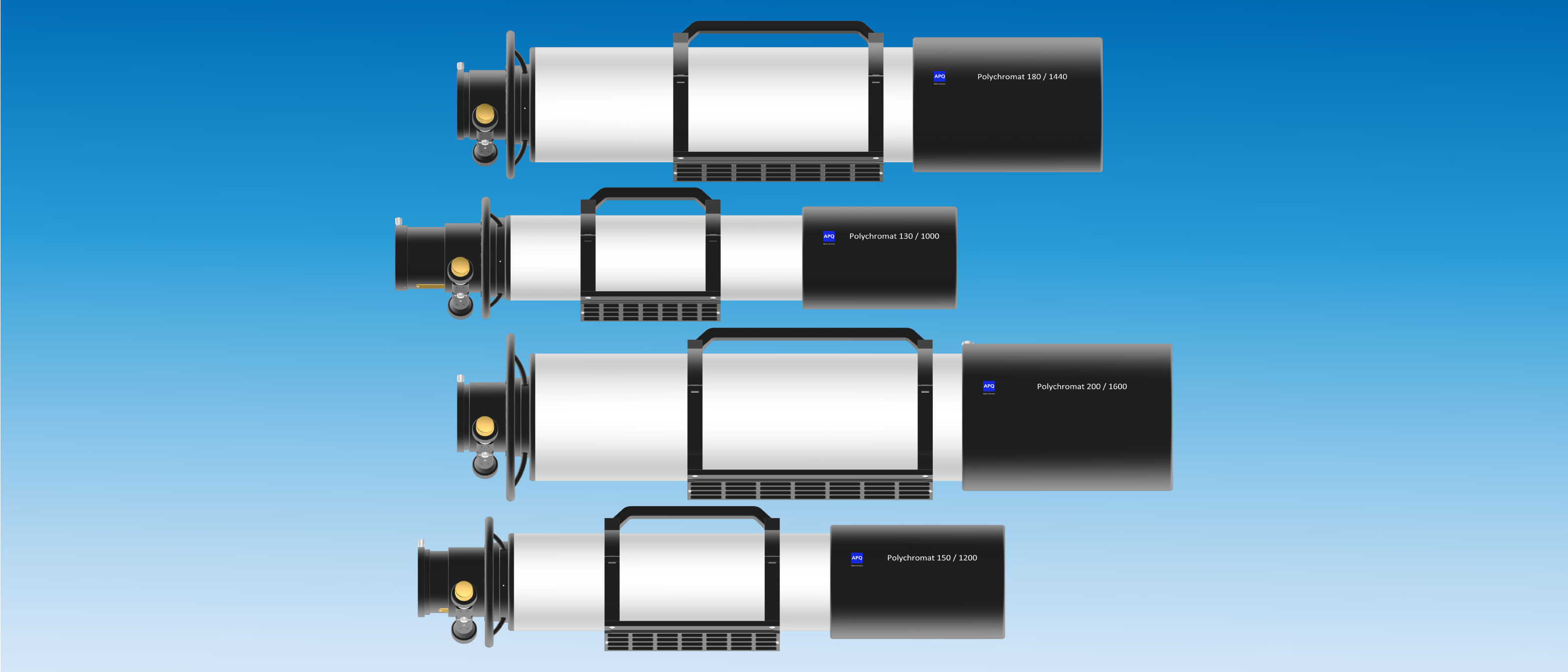
An optical system with advanced chromatic correction across several colors or a broad spectral range. In Haferkorn’s terminology, polychromatism denotes a design extending beyond simpler chromatic correction conditions. Its actual quality must always be evaluated over the specified spectral range and with relevant image-quality criteria.
Reference planes and points of first-order optics for a centered optical system. They permit a compound system to be represented by equivalent first-order quantities and define, among other things, where effective focal lengths and conjugate distances are referenced.
Q
A term widely used in astronomy for an objective or lens group consisting of four optical elements. “Quadruplet” describes the element count and does not automatically define the chromatic correction class.
The wavelength-dependent fraction of photons incident on a detector that produce registered photoelectrons or charge carriers. System performance requires QE to be considered together with Transmission, pixel size, read noise, and dark current.
R
Historical approximation according to which a maximum optical path difference of about λ/4 is often taken as a boundary for approximately diffraction-limited imaging. It must not be confused with the Rayleigh resolution criterion.
Ratio of reflected to incident optical radiant power at a surface or system. It depends on wavelength, angle of incidence, polarization, refractive indices, and coatings.
The ratio of the speed of light in vacuum to the phase velocity in a material. Refractive index depends on wavelength and temperature; its spectral variation is the basis of Dispersion.
Wavelength-dependent focal or imaging error remaining after chromatic correction. The shape and magnitude of the residual spectrum are decisive for how well an achromat, apochromat, superachromat, or polychromat is corrected over its intended spectral range.
The ability of an optical system to image closely spaced object structures separately. For an ideal circular aperture, the Rayleigh criterion describes the angular separation of two equally bright point sources. In astronomical practice, Seeing, contrast, detector sampling, and Signal-to-noise ratio can be more limiting than diffraction alone.
The root-mean-square deviation of a real Wavefront from a selected reference wavefront after defined terms such as tilt and defocus have been removed. RMS and peak-to-valley (PV) values are not directly interchangeable.
S
Two mutually perpendicular reference planes for off-axis ray bundles. The tangential or meridional plane contains the optical axis and chief ray; the sagittal plane is perpendicular to it. Different focal positions in the two planes characterize astigmatism. See also: Chief ray, Astigmatism
Discrete acquisition of a continuous image distribution by pixels. For digital imaging, the sampling must match the highest relevant spatial frequency; sampling that is too coarse causes aliasing and can make fine structures appear distorted. See also: Spatial frequency
The residual longitudinal chromatic aberration of an achromatically corrected system between or outside the reference wavelengths used for achromatization. Anomalous partial dispersion and additional design degrees of freedom can reduce it substantially.
Time-varying image blur and image motion caused by atmospheric turbulence. In ground-based astronomy, seeing often limits the practically achievable Resolving power more strongly than the telescope’s diffraction limit.
Classical third-order monochromatic aberrations: spherical aberration, coma, astigmatism, field curvature, and distortion. Seidel theory provides qualitative and quantitative insight into the origin of these aberrations and their dependence on field and aperture.
Wavefront sensor using a microlens array to divide the entrance aperture into many subapertures. The displacement of each focused spot from a reference position gives the local wavefront slope, from which the wavefront is reconstructed. See also: Wavefront reconstruction
The ratio of useful signal to the statistical variation of all relevant noise components. In detector practice these include photon noise from signal and background, dark current, and read noise.
Relationship between the angles of incidence and refraction at an interface between two isotropic media.
Number of periodic brightness or structure variations per unit length in the image plane, or per angular or object-space interval. Spatial frequency is the independent variable of the MTF and links resolution, contrast, and detector sampling. See also: Modulation Transfer Function (MTF)
Wavelength-dependent response of a detector or complete system to incident radiation. Depending on the definition, it can include detector quantum efficiency, gain, optical transmission, and filter response and must not be equated with quantum efficiency alone. See also: Quantum efficiency
A spectrograph disperses radiation spectrally and images the spectrum onto a detector. Spectroscopy is the analysis of spectral intensity distributions and lines; resolution, throughput, and spectral response are determined by the optics, slit or fiber, dispersive element, and detector.
Spherical aberration: marginal and paraxial rays have different axial intercepts even though they originate from the same axial object point. The error depends on aperture and on the shapes of the optical surfaces. See also: Aberration
The chromatic dependence of Spherical aberration, internationally usually called spherochromatism. An objective can be very well corrected for spherical aberration at a reference wavelength yet show different spherical aberration at other wavelengths. In broader usage, “Gauss error” is occasionally extended to the chromatic variation of other aberrations. See also: Aberration
A geometrical plot of selected ray intercepts in an image plane. Spot diagrams show the form and extent of geometrical aberrations for defined field points and wavelengths, but by themselves do not contain complete diffraction information.
Test of a telescope using intra-focal, extra-focal, and focused diffraction images of a star source. The star test is highly sensitive to aberrations and alignment errors but quantitative interpretation requires controlled conditions for seeing, wavelength, obstruction, and defocus.
Unwanted radiation in the image plane that does not follow the ideal geometrical path from the observed object. Sources include surface roughness, particles, ghost reflections, mounts, and inadequate baffling. Stray light especially reduces the contrast of faint structures. See also: Image contrast / contrast transfer
The ratio of the peak intensity of the real Point Spread Function (PSF) to that of the ideal diffraction-limited PSF at equal total energy and aperture. Strehl depends on wavelength, field, and focus; polychromatic Strehl values additionally require a defined spectral weighting.
Birefringence induced by mechanical stress in originally isotropic transparent materials. Differences in principal stresses produce a refractive-index difference through the photoelastic effect and can affect polarization and wavefront.
According to Herzberger and McClure, an advanced achromatic system corrected for four colors. The term denotes a chromatic correction class and by itself says nothing about field performance, Spherical aberration, or a very broad UV-to-NIR operating range.
Deviation of a real optical surface from its specified nominal form after defined alignment and removal of permitted degrees of freedom. It must be distinguished from surface roughness and cosmetic surface defects. See also: Surface roughness
General term for the quality of an optical surface with respect to localized defects such as scratches, pits, or edge chips. Scratch-dig is a widely used, primarily cosmetic classification and must not be confused with form error or surface roughness. See also: Surface roughness
Short-spatial-wavelength component of surface deviation from ideal form. Roughness influences stray light and losses in particular and is specified using suitable statistical parameters over a defined spatial bandwidth.
Systematic generation of an optical design from specified functions, constraints, and performance targets. It includes preliminary calculation or a starting system, selection of structure and materials, correction, numerical optimization, evaluation, and subsequent tolerancing.
Fraction of incident radiant power or photons that reaches the detector after all optical losses. Spectral system throughput combines transmissions, reflectances, filters, and, where applicable, geometrical losses.
T
A property of an optical system in which chief rays in object space or image space run parallel to the optical axis. Image-side telecentricity stabilizes incidence angles on sensors and filters but is not required for every astronomical application.
Paraxial relationship among focal length f, object distance g, and image distance b for a thin lens or an equivalently represented system. The signs depend on the convention used.
Evaluation of an RMS-based image-quality criterion over multiple focus positions. Depending on the analysis, this may be RMS spot radius or RMS wavefront error, for example; the exact quantity used must therefore be stated.
Complete reflection at an interface from an optically denser to an optically less dense medium when the angle of incidence exceeds the critical angle.
The ratio of radiant power transmitted by an optical element or system to incident radiant power. Spectral transmission T(λ) includes material absorption, reflection losses, and any filter action.
Lateral displacement of a real ray intersection from the ideal paraxial or geometrical image point in a specified image plane. Transverse aberrations are commonly evaluated in ray-fan or spot diagrams.
A chromatic correction class in which three selected colors or wavelengths satisfy a common paraxial focus condition. The term must be distinguished from the mechanical/optical construction as Doublet, Triplet, or Quadruplet.
A term used in astronomy and also by Haferkorn for an objective or lens group consisting of three optical elements. “Triplet” describes element count; a triplet is not automatically an Apochromat or Trichromat.
U
A photometric filter system consisting of U (ultraviolet), B (blue), V (visual), R (red), and I (near infrared). Modern practice often combines Johnson U/B/V with Cousins R/I. Effective wavelengths are not universal constants; they depend on the actual passbands, detector, and source spectrum.
The circular region in the image plane within which there is no geometrical obstruction by cells, stops, or downstream components. An unvignetted image circle does not automatically guarantee uniform illumination or constant image quality.
V
A field-dependent reduction in light caused by geometrical obstruction or by the natural angular dependence of an imaging system. Mechanical vignetting must be distinguished from natural illumination falloff.
W
Description of optical phenomena using the wave nature of light. It includes interference, diffraction, coherence, and polarization and complements geometrical optics where a pure ray model is insufficient.
A surface of equal phase of an optical wave. For an ideal point focus, the converging wavefront is spherical; departures from the ideal reference wavefront describe system aberrations.
The difference between a real and an ideal reference wavefront. It may be specified as a spatial function, an RMS value, or a peak-to-valley value. A meaningful specification states wavelength, aperture, measurement/calculation conditions, and any removed terms.
Mathematical determination of a spatial wavefront from measured local slopes, phase data, or intensity data. In a Shack-Hartmann sensor, for example, gradients derived from spot displacements are integrated or fitted to a basis such as Zernike polynomials. See also: Wavefront, Shack-Hartmann wavefront sensor (Hartmann-Shack sensor)
Interferometric method in which a wavefront is superimposed with a spatially shifted or tilted copy of itself. The resulting fringes contain primarily information about local wavefront gradients.
An optical system designed for high image quality over a comparatively large field angle or image circle. As the field increases, Coma, Astigmatism, Field curvature, Distortion, lateral color, and Vignetting become increasingly important.
Z
Orthogonal polynomial functions on the unit disk used to describe wavefront errors over a circular pupil. Individual modes can be associated with familiar aberration forms such as defocus, astigmatism, or coma; the numbering and normalization convention must be stated. See also: Wavefront error
Rotationally symmetric surface or wavefront error confined to particular radial zones of the aperture. Zonal errors can occur as local contributions to spherical aberration and can be detected by tests with radial resolution. See also: Spherical aberration
Literature and further reading
- [H81] Haferkorn, Heinz: Optik. Physikalisch-technische Grundlagen und Anwendungen. Harri Deutsch, Thun/Frankfurt am Main, 1981, ISBN 3-87144-570-3.
- [H67] Haferkorn, Heinz: Untersuchungen zur Glasauswahl und zur Vorrechnung bei Triplets. Dissertation, Technische Hochschule Ilmenau, 1967.
- [H86] Haferkorn, Heinz: Bewertung optischer Systeme. VEB Deutscher Verlag der Wissenschaften, Berlin, 1986.
- [HM63] Herzberger, Max; McClure, Nancy R.: "The Design of Superachromatic Lenses". Applied Optics 2 (6), 553–560, 1963. DOI: 10.1364/AO.2.000553.
- [KJ10] Kingslake, Rudolf; Johnson, R. Barry: Lens Design Fundamentals. 2. Auflage, Academic Press/Elsevier, 2010.
- [S00] Schroeder, Daniel J.: Astronomical Optics. 2. Auflage, Academic Press, 2000, ISBN 0-12-629810-6.
- [M07] Malacara, Daniel (Hrsg.): Optical Shop Testing. 3. Auflage, Wiley, 2007, ISBN 978-0-471-48404-2.
- [BW99] Born, Max; Wolf, Emil: Principles of Optics. 7., erweiterte Auflage, Cambridge University Press, 1999.
- [WS08] Smith, Warren J.: Modern Optical Engineering. 4. Auflage, McGraw-Hill, 2008.
- [B90] Bessell, M. S.: "UBVRI passbands". Publications of the Astronomical Society of the Pacific 102, 1181–1199, 1990. DOI: 10.1086/132749.
- [Sch17] Schubert, Ingo: Wissensspeicher Feinoptik 17.4. Saale Betreuungswerk der Lebenshilfe Jena gGmbH, Jena, 2017. ISBN 978-3-00-046972-5.
- [Su08] Suiter, Harold Richard: Star Testing Astronomical Telescopes – A Manual for Optical Evaluation and Adjustment. 2. Auflage, Willmann-Bell, Richmond, 2008.
- [PS01] Platt, Ben C.; Shack, Roland: "History and Principles of Shack-Hartmann Wavefront Sensing". Journal of Refractive Surgery 17 (5), S573–S577, 2001. DOI: 10.3928/1081-597X-20010901-13.
- [Y08] Yoder, Paul R., Jr.: Mounting Optics in Optical Instruments. 2. Auflage, SPIE Press, Bellingham, 2008. ISBN 978-0-8194-7129-1.
- [RV88] Rutten, Harrie G. J.; van Venrooij, Martin A. M.: Telescope Optics: Evaluation and Design. Willmann-Bell, Richmond, 1988. ISBN 0-943396-18-2.
- [R90] Riekher, Rolf: Fernrohre und ihre Meister. 2., stark bearbeitete Auflage, Verlag Technik, Berlin, 1990. ISBN 3-341-00791-1.
- [L17] Laux, Uwe: Astrooptik – Optiksysteme für die Astronomie. 3. Auflage, 2017. ISBN 978-3-937981-65-9.
- [G85] Grimsehl, Ernst: Lehrbuch der Physik. Band 3: Optik. 18. Auflage, neu bearbeitet von Heinz Haferkorn, B. G. Teubner, Leipzig, 1985.
- [HR84] Haferkorn, Heinz; Richter, Wolfgang: Synthese optischer Systeme. VEB Deutscher Verlag der Wissenschaften, Berlin, 1984.